

Cepheus: The King


| Object: | Cepheus |
| Location: | Narrowsburg, NY |
| Observer: | Roland Roberts |
| Time: | 10 Oct 2001 |
| Camera: | Pentax A3000, 50 mm f/2 lens |
| Film: | Kodak Elite Chrome II, ISO 200 |
| Exposure: | 11 minutes at f/4 |
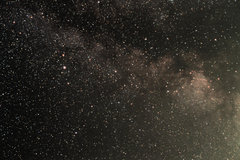
Not far from Cassiopeia lies Cepheus.
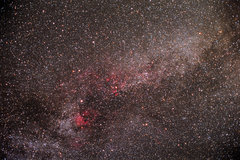
This was taken in mid-October of 2001 the same night I took a shot of Cassiopeia. This exposure was cut a little shorter than I had intended due to fog rolling in rather suddenly. Still, it came out reasonably well. Click on the image for a larger version.
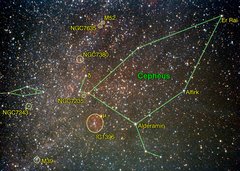
The constellation Cepheus is often described as a house shape (turn your head on its right side and squint). None of the stars in Cepheus are as extremely bright, and with it being so close to the Milky Way, it's not hard to miss it when you first go looking (well, I had a hard time finding it). Peaking into the picture at the left is the head of Lacerta, the Lizard and the upper left corner of this picture actually belongs to Cassiopeia.
Labeled in both of these pictures are the following objects:
- Open Clusters (6): M52 (NGC 7654 which is really in Cassiopeia), NGC 7380, NGC 7243 (which is really in Lacerta), IC 1396, M39 (which is actually in Cygnus), and NGC 7235.
- Emission Nebulae (1): NGC 7635
- Stars (5): α (alpha) – Alderamin, β (beta) – Alfirk, γ (gamma) – Er Rai, δ (delta) and μ (mu) Cephei.
ξ (Xi) Cepheus, also known as Kurdah, is not shown on the overlay.
Delta Cephei has no name, but does have a reputation. This is the prototypical Cepheid variable whose regular brightness fluctuations were first discovered by John Goodricke in 1784 [1].
Mu Cephei has a not so well-known name of Erakis and is perhaps better known as William Herschel's "Garnet Star." It is among the most (if not the most) red stars visible to the naked eye from the northern hemisphere. It is nestled up against the edge of IC 1396 and is, in fact, partially obscured by it which also contributes to its redness.
Resources:
[1] Burnham, Robert Jr., Burnham's Celestial Handbook, vol. 1, Dover Publications, 1978, p.583.
Fighting with G2Image
Okay, it’s not really fighting, but if feels that way. I misunderstood the instructions for setting up g2image and put the plugin under modules/tinymce/plugins because that directory already existed and had something in it, namely drupalbreak. Oops, that’s not where it is supposed to go, it has to go under modules/tinymce/tinymce/jscripts/tiny_mce/plugins. The clue came after …
Cassiopeia: The Queen
Cassiopeia:

| Object: | Cassiopeia and the Northern Milky |
| Location: | Narrowsburg, NY |
| Observer: | Roland Roberts |
| Time: | 10 Oct 2001 |
| Camera: | Pentax A3000, 50 mm f/2 lens |
| Film: | Kodak Elite Chrome II, ISO 200 |
| Exposure: | 16 minutes at f/4 |
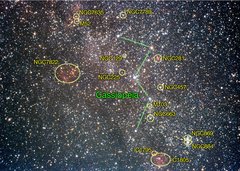
Cassiopeia lies high in the northern sky an is one of the few constellations which are visible year-round from the mid-northern latitudes where I live. Still, the fall and winter are the best times to view Cassiopeia since it lies further from the horizon that time of year. This was taken in mid-October of 2001 on a night when I had hoped to also get a second shot at Cygnus before it sank too low for this year.
The constellation Cassiopeia is often described as a "W" shape (turn your head on its left side and squint). The "W" is not symmetric, but it generally works for finding it in the northern skies.
Labeled in both of these pictures are the following objects:
- Open Clusters (7): M52 (NGC 7654), NGC 225, NGC 457, NGC 663, NGC 869, which together with NGC 884, form the the well-known "Double Cluster" in Perseus, and NGC 7789, an open cluster
- Emission Nebulae (5): IC 1795, IC 1805, NGC 281 (the "Pacman Nebula"), NGC 7635 (the "Bubble Nebula"), and NGC 7822
- Stars (2): Schedir and Caph
Also visible in the image are the stars Achird, Cih, Rucha, and Segin.
The film response of Elite Chrome II seems a bit stronger in the red than the blue which lends an overall reddish hue to everything. Additionally, the color shift (according to Robert Reeve's evaluation) is brownish for long exposure. To compensate for these effects, the color balance has been slightly shifted toward the blue in these images.
Resources:
Capricornus: The Sea Goat

| Object: | Capricornus |
| Location: | Savoy, MA |
| Observer: | Roland Roberts |
| Time: | 8 Aug 2002 |
| Camera: | Pentax K1000, 50 mm f/1.4 lens |
| Film: | Kodak Elite Chrome II, ISO 200 |
| Exposure: | 30 minutes at f/2.8 |
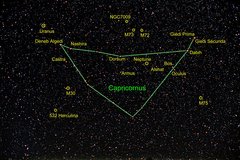
Capricornus lies low in the southern sky as seen from the mid-northern latitudes. It is most easily visible in late-summer (depending on how late you like to stay up, you can see it in early summer). Like most areas away from the Milky Way, Capricornus looks relatively bare. Only one Messier object lies in Capricornus.Capricornus looks to me more like a big "V" or even an open mouth than a sea-goat, but I don't get to name constellations… At the time this photograph was taken, two planets and several asteroids were visible in the constellation of Capricornus, although only one of the asteroids was bright enough to show up unambiguously in this photo and even then, only when viewing it at the 800-pixel wide size or larger. Uranus is/was a (marginally) naked eye object, provided you know where to look. Neptune requires at least binoculars. Neither are very impressive. However, they can be distinguished from stars using a telescope, something which is true of all the planets except Pluto. Labeled in the picture are the following objects:
- Planets (2): Uranus and Neptune.
- Asteroids (1): 532 Herculina, which unknown to me at the time, was at its brightest for the year at magnitude 10.2. You can find orbital elements for 532 Herculina at CfA Planetary Sciences Division web site. David Richards has a couple of frames from early 2000 showing the movement of this asteroid over a 24-hour period. Herculina is a main-belt asteroid.
- Globular Clusters (3): M72, M75, and M30.
- Open Clusters (1): M73.
- Planetary Nebulae (1): NGC 7009.
- Stars (2): Giedi Prima, Giedi Secunda, Dabih, Oculus, Nashira, Bos, Armus, and Dorsum, Castra, Deneb Algedi, and Alshat.
With the exception of M30, all the Messier and NGC object are actually part of Aquarius.
Resources:
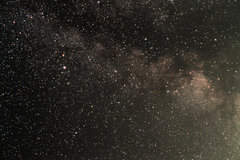
Aquila: The Eagle

| Object: | Aquila | ||||
| Location: | Narrowsburg, NY | ||||
| Observer: | Roland Roberts | ||||
| Time: | 2002-Jul-12 02:55 EDT | ||||
| Camera: | Pentax Spotmatic, 50 mm f/1.4 lens | ||||
| Film: | Fuji Provia 400F, push +1 | ||||
| Exposure: | 20 min @ f/4 | ||||
| Processing: |
|
Stay away from the horizons when you shoot! This shot was taken with Aquila still fairly high up, but you can see the encroaching sky glow in the lower right corner. I did attempt to remove some of the glow by adding a gradient with a color cast the same as the glow then doing a global color correction and contrast enhancement. It helped, but you can see there is still some left. Unfortunately, the only techniques I know for gradient removal will also remove the Milky Way!
Resources:
Constellations
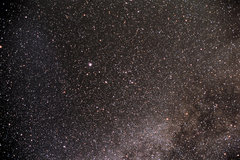
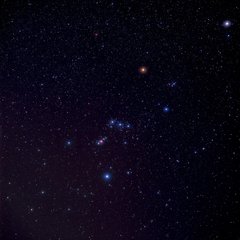
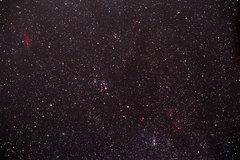
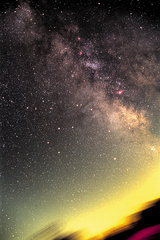
Film photography is, in one sense, the easiest of the possible ways to get pictures of the night sky. In fact, with nothing more than a camera and a tripod, you can start taking pictures and pick out the brighter stars with exposures of as much as 20–30 seconds, depending on what part of the sky you are pointed at. If you don’t mind star trails, you can expose for much longer. And, if are at least a little mechanically inclined, you can build a barn-door tracker which will let you take exposures of up to 10 minutes (or even an hour with a more sophisticated design. A barn-door tracker is not what we used here. I have only a modest set of mechanical skills and we live in an apartment which is large only by New York City standards. With two small children running about, power-tools and construction messes, even transient ones, are not a good idea. So I bought a CG5/EQ4 mount with drives and and a small “table top” to fit on the dovetail bracket where I can mount a camera. This is the expensive way to get started and the mount is overkill for the load I put on it, but I hope to eventually put something like the Celestron C5 Schmidt-Cassegrain on the mount. My set of portraits will slowly grow, and I hope to eventually have a collection as nice as what are on Jeff DeTray’s web site, but for now this is what I have.
 |
 |
 |
| Aquila | Capricornus | Cassiopeia |
 |
 |
 |
| Cepheus | Cygnus | Delphinus |
 |
 |
 |
| Hercules | Lyra | Orion |
 |
 |
 |
| Perseus | Sagittarius | Scutum |
 |
||
| Ursa Major |